Grant County Dog Registration Information
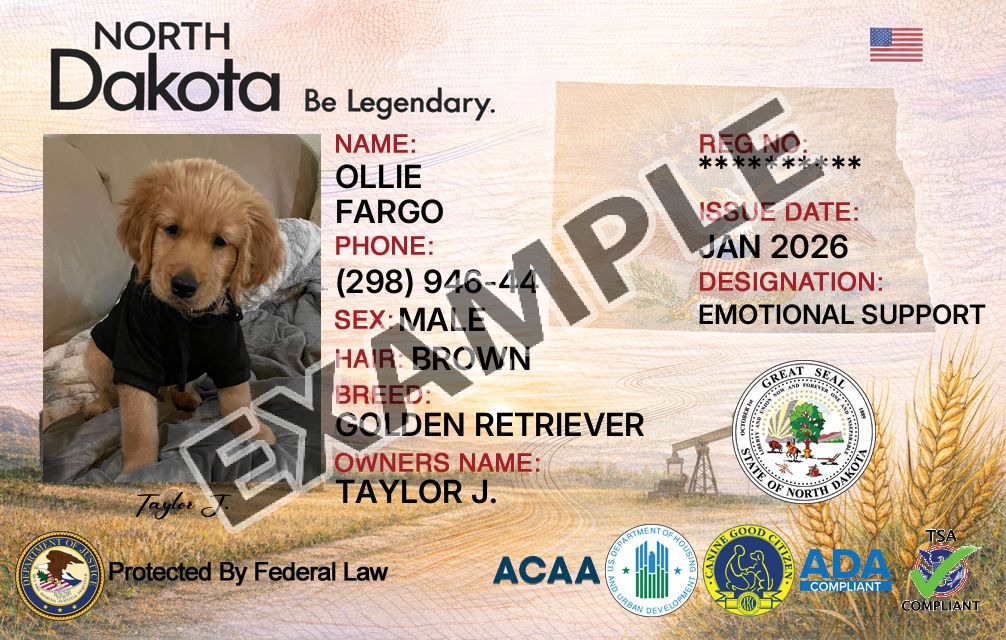
Service Dogs and Emotional Support Animals in Grant, North Dakota
If you’re searching where do I register my dog in Grant County, North Dakota for my service dog or emotional support dog, the key thing to know is that a dog’s license (when required) is typically handled locally—most often through a city office or a county law-enforcement or public health contact that oversees rabies compliance. A service dog or emotional support animal (ESA) status, on the other hand, is not created by a “registration” at the county courthouse.
This page explains how a dog license in Grant County, North Dakota generally works, what to do first, and which official offices are common starting points for an animal control dog license Grant County, North Dakota question—especially when you want to stay compliant with rabies rules and local ordinances.
Where to Register or License Your Dog in Grant County, North Dakota
Because licensing is often handled at the city level, the best answer to where to register a dog in Grant County, North Dakota depends on your address. If you live inside a city (for example, Carson or Elgin), start with that city’s office. If you live outside city limits, start with the county-level office that typically coordinates enforcement and referrals for animal issues.
Example Official Offices (Grant County, ND)
| Office | Contact Details | Hours |
|---|---|---|
Grant County Courthouse (Main County Office Location)Grant County, North Dakota
|
106 2nd Ave
Carson, ND 58529
Phone: 701-622-3615
|
8:00 a.m. – 4:00 p.m. (MT)
Closed for lunch 12:00 p.m. – 12:30 p.m.
|
Grant County Sheriff’s OfficeGrant County, North Dakota
|
106 2nd Ave NE
Carson, ND 58529
Phone: 701-622-3331
Email: jrfoss@nd.gov
|
Not listed
|
Grant County Recorder (Courthouse Office)Grant County, North Dakota
|
106 2nd Ave NE
Carson, ND 58529
Phone: 701-622-3544
|
Not listed
|
Grant County Election Office (Auditor/Administrative Contact)Grant County, North Dakota
|
106 2nd Ave NE
Carson, ND 58529
Phone: 701-622-3275
|
Not listed
|
NDSU Extension – Grant County OfficePublic information & referrals (not a licensing office)
|
106 2nd Ave
Carson, ND 58529-0137
|
Not listed
|
Overview of Dog Licensing in Grant County, North Dakota
Dog licensing is usually local (city-by-city)
In North Dakota, dog licensing requirements are commonly created and enforced through local ordinances. That’s why “Grant County” can’t always provide a single one-size-fits-all answer. In practice, whether you need a dog tag or annual license often depends on whether you live:
- Inside city limits (where city hall or a designated city office may issue licenses), or
- In unincorporated Grant County (where the county sheriff and county courthouse contacts may guide you to the right process and enforcement standards).
Rabies vaccination is the most common baseline requirement
Even when local licensing rules differ, rabies compliance is a consistent public health priority. Many local licensing systems require proof of current rabies vaccination before they will issue a dog license or tag. If you’re unsure what’s required for your exact address, call one of the official offices listed above and ask what documentation is accepted for licensing or rabies verification.
Licensing vs. “registration” for service dogs or ESAs
People often search for registration because they want their dog recognized as a service dog or emotional support dog. But a dog license in Grant County, North Dakota is about local animal regulation (public safety, identification, rabies control). It does not create a service dog or ESA status by itself—and you should be cautious of non-government “registries” claiming to issue official credentials.
How Dog Licensing Works Locally in Grant County, North Dakota
Step 1: Confirm your jurisdiction (city limits vs. county)
The first step in figuring out where to register a dog in Grant County, North Dakota is identifying which local rules apply to your home address:
- If you live in a city (e.g., Carson, Elgin): Start with city hall or the city office that handles utility billing, permits, or ordinances. Many communities handle dog licensing through the city clerk’s office or city administration.
- If you live outside a city: Start with the Grant County Sheriff’s Office or the Grant County Courthouse main contact and ask who handles animal control complaints, dog-at-large enforcement, and rabies checks for your area.
Step 2: Ask what the local license covers
When you reach an official office, ask specifically whether they issue:
- Annual dog licenses/tags
- Kennel licenses (if you keep multiple dogs)
- Rabies compliance checks or reporting procedures
- Rules for dogs running at large, nuisance barking, or bite reporting
This helps you get to the right form and avoid paying the wrong office. It also helps clarify whether your question is really about licensing, rabies enforcement, or a service animal accommodation issue.
Step 3: Prepare documentation (rabies, ID, residency)
Most local licensing systems are straightforward once you have the right paperwork. Typically, you’ll provide proof of rabies vaccination and basic owner information. Some communities may also ask for proof you live in the jurisdiction.
Service Dog Laws in Grant County, North Dakota
What makes a dog a service dog
A service dog is generally understood as a dog that is individually trained to do work or perform tasks for a person with a disability. The dog’s legal status comes from the dog’s training and function—not from paying a fee to “register” online, and not from a special county license label.
Do service dogs need a local dog license?
In many places, service dogs are still expected to follow public health requirements like rabies vaccination, and local ordinances may still apply unless an exemption exists in the specific local code. That means your service dog may still need a local tag depending on the rules where you live. For the most accurate answer, ask the issuing office:
- Whether service dogs are exempt from licensing fees or licensing requirements
- Whether rabies documentation is still required
- Whether an identifying tag is required for dogs within city limits
What businesses and landlords may ask
If your question is about access to public places, remember: businesses generally focus on whether the dog is a trained service animal and whether it is under control and housebroken. For housing, additional rules may apply. None of these are created by a “service dog registration” website.
Emotional Support Animal Rules in Grant County, North Dakota
ESAs are not the same as service dogs
An emotional support animal (ESA) is not the same thing as a service dog. ESAs provide comfort or support by their presence, but they are not trained to perform specific tasks related to a disability in the way a service dog is.
Do ESAs have to be licensed locally?
If your community requires a dog license, an ESA is generally treated like any other pet for licensing purposes. So if you’re trying to figure out animal control dog license Grant County, North Dakota requirements for an ESA, the practical answer is: follow the same local licensing steps and rabies rules that apply to other dogs at your address.
Housing vs. public access
ESA rules most commonly come up in housing contexts rather than public access. If your goal is housing accommodation, you may be focused on documentation for a housing provider rather than a county “registration.” However, even in housing situations, you may still need to comply with local pet licensing and vaccination requirements.
Frequently Asked Questions
Register A Dog In Other North Dakota Counties
Select your county below to get started with your dog’s ID card. Requirements and license designs may vary by county, so choose your location to see the correct options and complete your pup’s registration.
- Adams County Dog Registration
- Barnes County Dog Registration
- Benson County Dog Registration
- Billings County Dog Registration
- Bottineau County Dog Registration
- Bowman County Dog Registration
- Burke County Dog Registration
- Burleigh County Dog Registration
- Cass County Dog Registration
- Cavalier County Dog Registration
- Dickey County Dog Registration
- Divide County Dog Registration
- Dunn County Dog Registration
- Eddy County Dog Registration
- Emmons County Dog Registration
- Foster County Dog Registration
- Golden Valley County Dog Registration
- Grand Forks County Dog Registration
- Griggs County Dog Registration
- Hettinger County Dog Registration
- Kidder County Dog Registration
- LaMoure County Dog Registration
- Logan County Dog Registration
- McHenry County Dog Registration
- McIntosh County Dog Registration
- McKenzie County Dog Registration
- McLean County Dog Registration
- Mercer County Dog Registration
- Morton County Dog Registration
- Mountrail County Dog Registration
- Nelson County Dog Registration
- Oliver County Dog Registration
- Pembina County Dog Registration
- Pierce County Dog Registration
- Ramsey County Dog Registration
- Ransom County Dog Registration
- Renville County Dog Registration
- Richland County Dog Registration
- Rolette County Dog Registration
- Sargent County Dog Registration
- Sheridan County Dog Registration
- Sioux County Dog Registration
- Slope County Dog Registration
- Stark County Dog Registration
- Steele County Dog Registration
- Stutsman County Dog Registration
- Towner County Dog Registration
- Traill County Dog Registration
- Walsh County Dog Registration
- Ward County Dog Registration
- Wells County Dog Registration
- Williams County Dog Registration